The Fool Tarot Card Meaning
Upright: The Fool represents starting something before you know how it will turn out.
Reversed: It can point to rushing past a warning or putting off a beginning because you want certainty.
If you drew The Fool, ask: what is new here, and what do I need to check before I act?
By Nil Ni · Updated
A short preview is available without signing in. Full readings require signing in and credits.
The Fool upright
The Fool is the beginner in the deck. In a reading, it can describe the excitement of a first date, a class you have never tried, or an idea that has yet to become a plan.
Consider what you can learn by taking one manageable step. Applying for a course gives you information; paying for it without checking the schedule creates a different kind of commitment. The card does not tell you which outcome will follow.
The Fool reversed
Check two possibilities. Are you overlooking a detail because you want to begin? Or have you checked what you can and still keep postponing the first step?
If you are rushing, name the missing information. If you are stuck, choose an action with a limited commitment, such as asking about the course before enrolling.
The Fool in love
Upright: Use the card to reflect on openness in a new connection. If you already have a partner, it can prompt a conversation about trying something together.
Reversed: Look at pace and expectations. Have you discussed what each of you wants, or are you filling in the gaps yourself?
The Fool cannot establish how another person feels or promise that an ex will return. A direct conversation gives you information a card cannot.
The Fool in career readings
Upright: A new role or skill can be a useful focus for this card. Write down what interests you about the work and one way to learn more about it.
Reversed: Compare enthusiasm with the details you have checked. Read the job description and ask about responsibilities before making a commitment. A tarot card is not a reason to leave a job or risk savings.
Is The Fool a yes or no?
In this guide, upright leans yes for exploring a beginning. Reversed suggests pausing to examine hesitation or missing preparation. Readers use different yes/no conventions.
For “Should I apply for the class?” this can be a prompt to explore. For “Will the class change my life?” the card cannot give you a reliable answer. Use tarot for entertainment and reflection, not a prediction or professional advice.
The Fool with other cards
These are examples of reading two themes together. Your question and the cards’ positions still matter.
- The Fool + The Magician: Connect a new idea with a skill you already have. What can you make with the tools available?
- The Fool + The Lovers: Consider how a beginning fits your values and commitments. Who else needs a say?
- The Fool + The Tower: Consider what is changing before adding another commitment. This pair does not prove that a disaster is coming.
Reading the picture
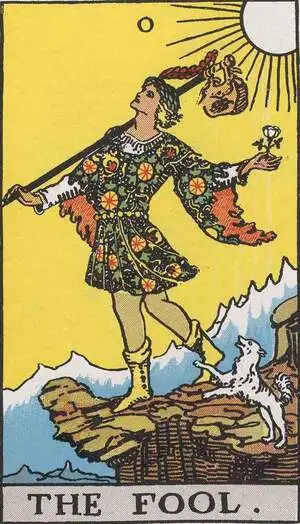
In the Rider–Waite–Smith tradition, the figure near a cliff gives you a visual contrast between curiosity and danger. The small bag can prompt a question about what you need to carry into a new experience. Other decks depict The Fool differently.
The figure, cliff, and bag appear in A. E. Waite’s description of The Fool in The Pictorial Key to the Tarot. TarotRead’s reflection prompts and card pairings are editorial interpretations.
Common questions
Is The Fool reversed a bad card?
A reversed Fool can prompt you to check your preparation. Check whether you are avoiding a start or ignoring a warning.
Does The Fool reveal someone’s feelings?
No card can verify another person’s private thoughts. Use the reading to consider your own expectations and what you want to ask them.
Do I need another card?
You can stop with one card and write down what it brought to mind. If you choose a spread, give each position a clear question rather than drawing repeatedly for a preferred answer.
Try a short preview on the homepage. Full readings require signing in and credits.